


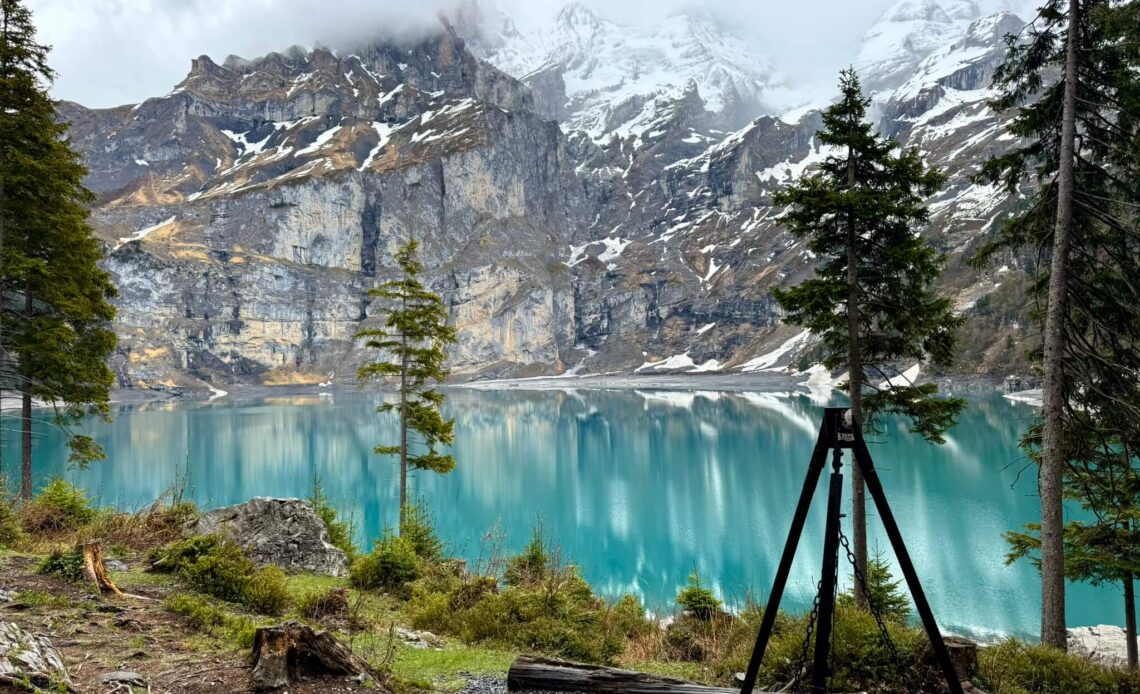
Oeschinensee is one of those places in Switzerland that you have probably already seen in photos. Bright blue water, steep mountain walls, boats on the lake and snow-covered peaks in the background. It is one of the best-known mountain lakes in the Bernese Oberland, and honestly, that is not without reason.
But almost everyone visits Oeschinensee by taking the cable car from Kandersteg. We did not. We were there at the beginning of May, just before the summer season really started. The cable car was still closed, several hiking trails were blocked and the area felt like it was still slowly waking up after winter.
So there was only one option: hiking all the way up from Kandersteg. It was harder than the standard route with the gondola, but that may have made it even more beautiful. In this blog, I will tell you what our Oeschinensee hike without the cable car was like, what you can expect along the way and what you need to consider when visiting this mountain lake in spring.
Contents
Kandersteg: a great base for Oeschinensee
Kandersteg is a mountain village in the Bernese Oberland region, at the foot of the Swiss Alps. It is the kind of place where you step outside in the morning and immediately feel like going for a hike. There are mountains all around you, wooden chalets, fresh air and plenty of walking routes that start directly from the village.
We stayed in a lovely holiday home in Kandersteg. That was ideal for this hike, because I could simply leave directly from our accommodation in the morning. We had also stayed here before at Camping Rendez-vous, a relatively small campsite in a beautiful location close to Oeschinensee.
From the campsite or an accommodation in the village, you can walk to Oeschinensee in a few hours. But this is certainly not the only hike in the area. From Kandersteg, you can also take beautiful walks towards places such as the Lötschenpass Glacier.

Visiting Oeschinensee without the cable car
During the main season, visiting Oeschinensee is quite simple. You take the cable car up from Kandersteg and walk from the mountain station to the lake in about 20 minutes. This is the route most visitors take.
But in spring, the cable car may still be closed. When we visited at the beginning of May, that was exactly the case. There was no gondola, no crowds around the mountain station and no summer atmosphere with boats and busy terraces. It did mean that I had to hike all the way up from Kandersteg.
That makes the experience completely different. You have to work harder for it, but you also get much more peace and quiet in return. While the lake can be very busy in summer, I walked almost completely alone on some parts of the route.
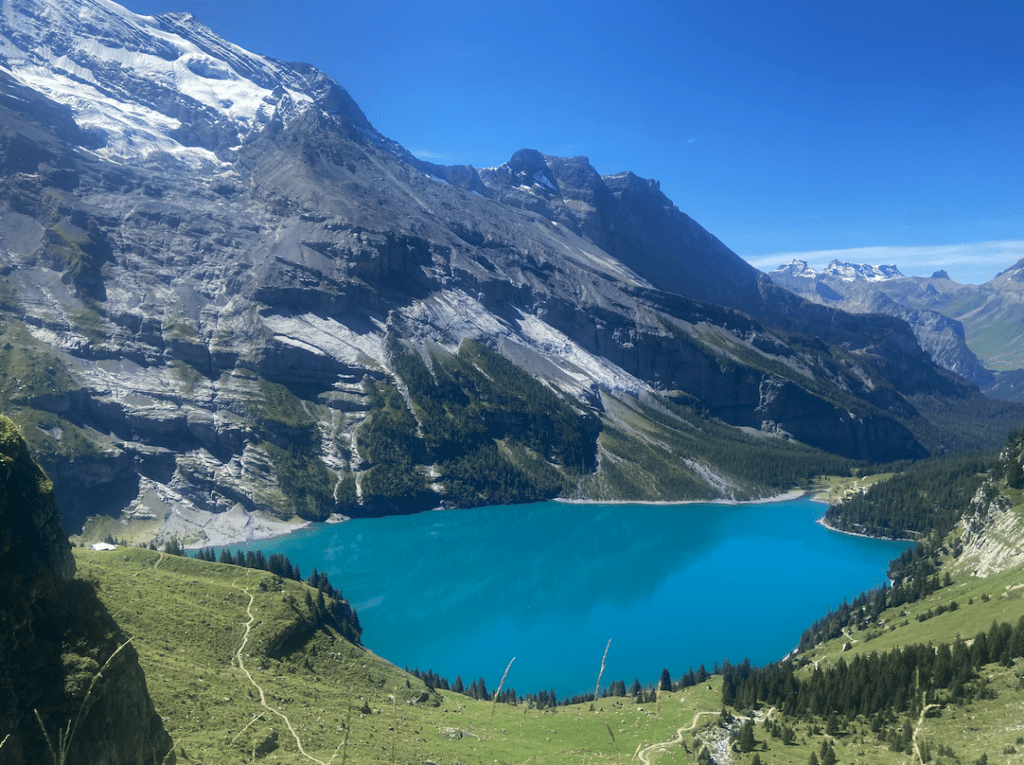
Below, you can see a photo from an earlier visit during summer.
Always check the current status of the cable car, restaurants and hiking trails before you leave. Especially in April and early May, there may still be snow and not all trails will be open. The Oeschinensee webcams are also useful. They allow you to see the weather and visibility at the lake live.


The start of the hike from Kandersteg
Because I started directly from our accommodation, I did not need to take the car and immediately saved the parking costs. I left early, and that turned out to be a very good choice. The air was fresh, the mountains were still partly in the shade and there were hardly any other hikers.
The beginning of the route is not immediately the most beautiful part. You first walk along a gravel road. There was also construction work taking place when I was there. It was not exactly the romantic Swiss view you may have in mind, but luckily this section does not last long.
After that, you reach a kind of entrance point to the hiking area. There is also a wooden squirrel here, which is a funny detail along the way. From this point, the real work begins.

A steep climb with beautiful views
The hike to Oeschinensee without the cable car is not a flat walk. You climb around 500 to 600 metres and walk about 4 kilometres each way. Allow around 1.5 to 2 hours for the climb, depending on your pace, photo stops and the conditions on the trail.
The route is not technically difficult, but it is demanding. You hike upwards in a zigzag and slowly rise higher above Kandersteg. This is the kind of climb where you need to find your pace and avoid starting too quickly.
The views along the way make the climb more enjoyable. You get better and better views over the valley of Kandersteg and see several waterfalls flowing down the mountain walls. Especially in spring, with melting snow and patches of snow higher up, this gives the route a wonderful atmosphere.
Take your time. It is not a race. In fact, if you are doing this hike because the cable car is closed, I would take it especially slowly. You will enjoy the lake much more when you arrive if you are not completely exhausted.

The final section towards Oeschinensee
After about 45 minutes to one hour, I reached a wider paved road. This road is also used to deliver supplies to the restaurant at the top. Hikers also join the route towards the lake here.
From here, it feels like you are almost there. Shortly before the end, you can also see the mountain station of the cable car. During the season, most visitors arrive there and then only have to walk the final section to the lake.
This final section is easy to walk. When the cable car is open, this part is also suitable for people who do not want to complete a long hike. There are still a few height differences, but compared with the climb from Kandersteg, it is not much.

The first view of Oeschinensee
And then you suddenly see it: Oeschinensee.
The first thing I noticed was that the water did not immediately have the bright blue colour you see in photos. It looked more grey. For a moment, I thought: is this really it?
But as soon as I walked a little further along the left side of the lake, the view changed completely. Because of the different light and perspective, the water suddenly became bright blue. Clear, fresh and exactly how you hope a Swiss mountain lake will look.
Oeschinensee lies at an altitude of around 1,578 metres and is fed by meltwater from the surrounding mountains, including Blüemlisalp. This meltwater contains fine minerals, also known as glacier flour. These particles reflect the light and create the lake’s famous blue colour.
Oeschinensee in spring: quieter, but fewer facilities
What made this hike really special for me was the peace and quiet. Because the cable car was still closed, the season had not yet started and some of the hiking trails were still blocked, I was completely alone beside the lake at one point.
That probably does not happen very often here in summer. Oeschinensee is then a popular day-trip destination, with lots of hikers, boats on the water and full car parks down in Kandersteg.
Spring therefore has some clear advantages. There are fewer people, more silence and snow-covered mountain peaks around the lake. But there are also disadvantages. Restaurants may still be closed, boats may not yet be available and some of the higher hiking routes may not be safe or accessible.
The landscape is also not yet fresh and green everywhere. You notice that winter has only just ended. But honestly, I really liked the combination of snow on the mountains, cold water and almost nobody around.
Hiking routes around Oeschinensee
There are several hiking routes around Oeschinensee. If you want to take it easy, you can walk from the mountain station to the lake during the season and follow the shore for a short distance. This is the easiest option.
If you have more hiking experience and the trails are open, the panoramic trail towards Oberbärgli and Unterbärgli is a popular choice. This route runs higher above the lake and offers beautiful views. During the season, you can also stop at mountain huts along the way for something to eat or drink.
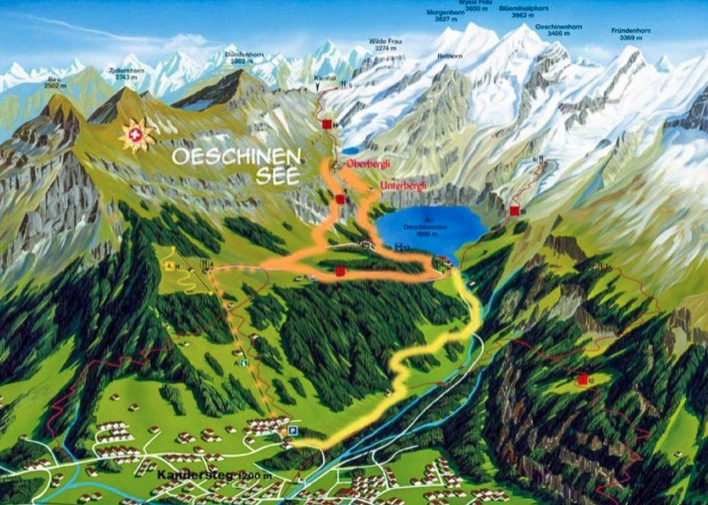
Be aware that these higher routes are not always open or safe in spring. When I was there, parts of the area were still closed. Always check the latest trail information before starting a longer hike.

Walking a little further along the lake
At the lake, I walked a little further to the left. I would definitely recommend doing this, because I thought the colour of the water became much more beautiful from this side. You also get different views of the mountains around the lake.
Along the way, I found a small waterfall that you can even walk behind for a short distance. It is not especially powerful, but it is a fun extra detail. Because it was so quiet, I had plenty of time to simply look around.
The water level was still quite low. In summer, with more meltwater, the lake probably looks fuller. This makes Oeschinensee in spring look slightly different from the summer photos you often see online.
Other activities around Oeschinensee
In summer, there is more to do at Oeschinensee than just hiking. You can rent a boat and row across the lake, have a picnic on the shore or eat and drink something at the restaurant. On warm days, you may also see people entering the ice-cold water, although you need to be able to handle the cold.

In winter, the area changes into a snowy landscape. Depending on the conditions, you can hike, go sledging or enjoy a completely different view. Oeschinensee is therefore not only a summer destination, although the experience is very different in each season.

Walking back down
The descent was of course faster than the climb. However, I would not underestimate it. Walking downhill requires extra attention in some places, especially when there are loose stones, mud or wet sections on the trail.
After such a climb, your legs are often already a little tired, which makes it easier to take a wrong step. Good footwear is therefore important. Especially in spring, when the trails may be wet, I would not do this hike in slippery trainers.
Also take enough food and drinks with you. If the facilities at the lake are still closed, you cannot simply rely on being able to buy coffee, lunch or water there.

Parking at Oeschinensee
If you are not starting directly from your accommodation in Kandersteg, you can park at the valley station of the cable car. There are several car parks, including P1, P2 and P3.
Expect to pay for parking. When I checked, it cost around 4 CHF per hour, often with a minimum stay of 3 hours. This means you will quickly spend around 12 CHF before you have even started the hike.
Useful to know: P2 has charging points for electric cars. Motorhomes cannot simply use the car parks at the valley station because there is a height restriction. Check this in advance if you are travelling by motorhome.

Staying overnight in Kandersteg
In my opinion, Kandersteg is the best base for visiting Oeschinensee. This is especially true if you want to start early or hike up without driving first. We stayed in a holiday home in the village with a view of the mountains. That made starting the day very easy.
You can find hotels, apartments and holiday homes in Kandersteg. Personally, I think an apartment or holiday home is ideal here, because you can have breakfast at your own pace, prepare your things and have your own place to recover after the hike. You could add a Booking map with accommodation in Kandersteg below, for example.
Some well-known options in Kandersteg include Hotel Ermitage, close to the cable car to Oeschinensee, Belle Epoque Hotel Victoria & Apartments, which is convenient if you want to stay in the centre of the village, and Hotel Bernerhof, also located centrally in Kandersteg. If you are travelling with children, Hotel Alpina may be an interesting option because of its garden and family rooms.

Combining Oeschinensee with Blausee
If you are staying in Kandersteg, you can easily combine Oeschinensee with Blausee. This is a much smaller lake in the forest, with incredibly clear blue water and trout. It is a completely different place from Oeschinensee: smaller, easier to reach and more suitable for a short stop than a real hike.
We thought Blausee was a lovely and peaceful addition to our time in the area. Especially if you do not want to complete another demanding hike after visiting Oeschinensee, this is a pleasant place for a short visit.

Oeschinensee with or without the cable car?
The best choice depends on when you are travelling and what you are looking for. Do you want an easy visit, are you travelling with small children or do you have limited time? In that case, the cable car is simply the most practical option during the season. From the mountain station, you can quickly reach the lake without first climbing 500 to 600 metres.
Would you prefer more peace and quiet, are you fit enough for a demanding climb and do you enjoy really working towards reaching the lake? Then hiking from Kandersteg is a wonderful experience. Especially in spring, when the area is still quiet, it feels much more natural.
I would especially recommend the hike without the cable car if you have good footwear, allow enough time and check in advance whether the weather and trails are suitable. It is not a technical mountain hike, but it is still a real climb.
Practical tips for Oeschinensee without the cable car
- Check the webcams in advance. Especially in spring, the visibility at the lake can be very different from the weather in Kandersteg.
- Check whether the cable car is open. The gondola may still be closed in spring.
- Start early. This gives you more peace, beautiful light and enough time at the lake.
- Allow 1.5 to 2 hours for the climb. The hike from Kandersteg is demanding.
- Wear good hiking shoes. Good grip is especially important during the descent and on wet sections.
- Bring food and drinks. Not everything is open outside the main season.
- Walk along the left side of the lake. I thought the colour of the water looked much more beautiful from there.
- Bring warm clothing. It can be cold at the lake, especially early in the season.
Oeschinensee without the cable car: harder, quieter and perhaps even more beautiful
Visiting Oeschinensee without the cable car is not the easiest option, but for me, it was a wonderful experience. You really have to climb for it, but that also makes the moment when you first see the lake feel even more rewarding.
At the beginning of May, the area was still quiet, slightly wintry and not yet completely open. That has disadvantages, but it also gives the place plenty of charm. There were no busy trails, no crowds beside the lake and, at some moments, only silence between the mountains.
If you mainly want convenience, take the cable car during the season. Would you prefer a harder, quieter and more natural experience? Then the spring hike from Kandersteg to Oeschinensee is a beautiful way to visit this mountain lake.

Easily book your trip to Switzerland
Flights
Rent a car or campervan
