


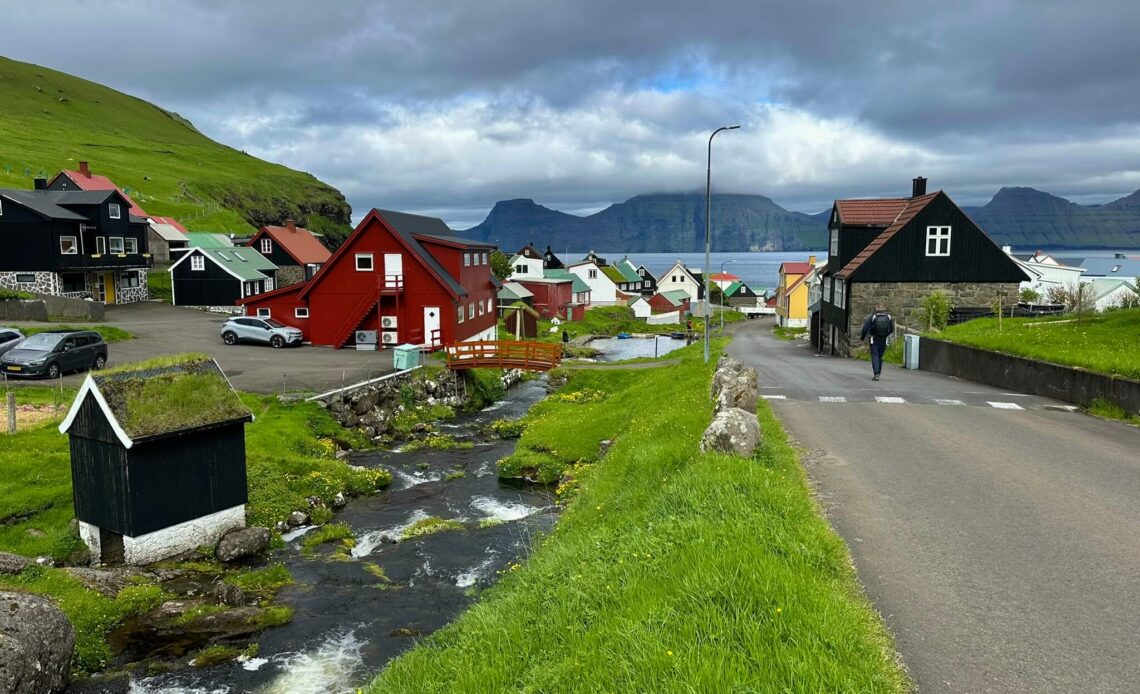
Gjógv is one of the best-known villages on Eysturoy, and you understand why as soon as you arrive. The village lies between high mountains and the sea, with a natural gorge that runs into the ocean like a narrow harbour. The route there alone is already beautiful enough to take your time for.
We visited Gjógv during our route across Eysturoy. It was a day where the roads, viewpoints and sheep played the main roles. Gjógv fitted perfectly into that: small, beautifully located and nice for a short walk around.
In this blog, I will tell you what you can do in Gjógv, what the gorge is like, how it works with puffins, parking, hiking and staying overnight in this special village in the Faroe Islands.
Contents
Where is Gjógv located?
Gjógv is located in the north of Eysturoy, one of the larger islands in the Faroe Islands. The village lies at the end of a beautiful route through mountains and along fjords. You do not just pass by here by accident; you drive here on purpose.
The name Gjógv literally means gorge. And that is exactly what the village is known for: a natural sea gorge of about 200 metres long, which was once used as a harbour. From the village, you can walk there easily. And in this gorge, you may be able to spot puffins.
We combined Gjógv with Hvíthamar, Funningur and Risin og Kellingin during our route across Eysturoy. Also read our blog about what to do on Eysturoy if you want to plan several stops in one day.

The route to Gjógv
We thought the route to Gjógv was one of the most beautiful drives on Eysturoy. You drive along water, between mountains and over roads where a new view appears after almost every bend. Along the way, we saw waterfalls coming down from the mountains and, of course, plenty of sheep on the road.
The road is narrow and winding in some places, but very manageable if you drive calmly. Parking in Gjógv was free and easy for us. There is a central car park in the village, so you do not have to search between the houses.
Keep in mind that the road along Slættaratindur, between Risin og Kellingin / Eiði and Gjógv, is normally only open from 1 May to 1 October. If you are travelling outside that period, check the route and current road status carefully in advance.
The village of Gjógv
Gjógv is small, quiet and very photogenic. You will find colourful houses, grass roofs, a small church, mountains behind the village and the sea in front of it. It is not a place where you tick off a long list of activities, but rather a village to walk through slowly.
What stood out to us is that the mountains around Gjógv felt higher and closer than in some other places in the Faroe Islands. It also seemed a little less windy for us, and we had better weather than in other parts of the island. That can of course be coincidence, because the weather here is anything but predictable. But for us, Gjógv felt surprisingly pleasant and sheltered.
With a baby, Gjógv was also a nice stop. You can get out of the car for a while, walk around calmly and you do not immediately need to do a tough hike to see something beautiful.
The natural gorge of Gjógv
The best-known spot in Gjógv is the natural gorge. From the village, you walk to the end of the valley, where the gorge opens into the sea. Via steps and paths, you can get closer to the water.
This really is the heart of the village. You hear the water hitting the rock walls and can clearly see how the gorge could once be used as a natural harbour. It is not a huge walk, but it is a beautiful place to stop for a moment.
From the left side of the gorge, you can walk a little uphill to Crown Princess Mary’s Bench. This bench was placed in honour of the visit of Danish Crown Princess Mary in 2005. From here, you already have a very nice view, without having to do a long walk straight away.
Do you need to hike in Gjógv?
You can hike further up along the cliffs in Gjógv. You do have to pay for that. We did not do it, because we had just done the Hvíthamar walk before this and mainly wanted to look for puffins near the gorge.
From the bench, you already have a lovely view, so at that moment we did not feel the need to walk any farther up. That is exactly what is nice about Gjógv: you can make the stop as short or as extensive as you like.
If you have lots of energy, good weather and feel like getting more views, that hike can of course still be fun. But if you have already done Hvíthamar or are travelling with children, walking around the village and the gorge is also enough to experience Gjógv properly.
Spotting puffins in Gjógv
Around the cliffs near Gjógv, you can see puffins. We mainly spent some time watching to see if we could spot them. They were not close enough for nice photos, but it is still fun when you see them flying or heading towards the water.
Just do not expect a zoo-like moment. Puffins are small, quick and they are not always exactly where you want them to be. Binoculars would not be a bad idea here.
Even without a good puffin photo, we thought this was a nice place. Searching for those small birds automatically makes you linger a little longer near the gorge and the cliff edge.
Café and staying overnight in Gjógv
In Gjógv, you will also find Gjáargarður, a guesthouse with a grass roof. This is handy if you want something to drink, lunch or simply a place to sit inside for a while. Especially on a cold or wet day, that is not an unnecessary luxury in the Faroe Islands.
You can also stay overnight in Gjógv. That seems especially nice to us if you really want peace and quiet and want to experience the village in the evening or early morning, without day visitors. Accommodation is limited though, so book in time if you want to sleep here.
A logical option is Gjáargarður Guesthouse, right in Gjógv. It is beautifully located in the village and practical if you want to explore the area at a slower pace. You can also look for small holiday homes or apartments in and around Gjógv, but do not expect a large hotel selection.

Combining Gjógv with Hvíthamar and Eysturoy
Gjógv is very easy to combine with Hvíthamar. We first did the short walk at Hvíthamar and then continued to Gjógv. That meant we had already enjoyed a beautiful viewpoint and could take things a little slower in Gjógv.
Read our blog about Hvíthamar viewpoint on Eysturoy here.
You can also combine Gjógv with Funningur, Eiði and Risin og Kellingin. That turns it into a beautiful route through North Eysturoy. Do pay attention to the seasonal road along Slættaratindur if you are travelling outside summer.
Gjógv: small village, big setting
Gjógv is not a place where you need a full day of activities. But that is not necessary either. The village is beautifully located, the route there is scenic and the natural gorge makes it just a little different from other villages in the Faroe Islands.
We especially liked its location. Mountains all around, the sea in front, puffins near the cliffs and a village small enough to remain calm. Combine Gjógv with Hvíthamar and Funningur, and you have a very nice day on Eysturoy.

Easily book your trip to the Faroe Islands
Flights
Hotels & apartments
Car rental
