


Aoraki/Mount Cook National Park is a rugged land of ice, glaciers and mountains. No fewer than 19 peaks rise above 3,000 meters, with Mount Cook itself as New Zealand’s highest mountain (3,724 m). It feels like you’re standing right in the heart of the Southern Alps. This is pretty much New Zealand’s #1 destination — and probably the reason you ended up on this blog. We stayed here for three days (two nights), and I’m going to tell you everything about why you’ll want to come here too!
Contents
What you need to know about Mount Cook National Park
Aoraki/Mount Cook National Park is a rugged landscape of ice and rock. There are 19 mountain peaks over 3,000 meters, including New Zealand’s highest mountain: Mount Cook (3,724 m). The park sits in the Southern Alps and is part of the UNESCO World Heritage area Te Wāhipounamu.
Mount Cook Village itself is small and basic. You’ll find a handful of accommodations, including the famous Hermitage Hotel, plus a visitor centre. Despite the remote location, the park attracts thousands of visitors every year. And that makes total sense: this is New Zealand’s hiking and photography paradise.
Another fun fact: Mount Cook sits right in the Aoraki Mackenzie Dark Sky Reserve, one of the darkest places on earth. That’s why you’ll see a night sky here that you’ll never experience back in Europe.
3 nights at Mount Cook: and we still didn’t see it all
We stayed for three days (two nights) in Mount Cook Village and slept at The Hermitage Hotel. From our suite we had an unreal view of Mount Cook. Enjoying that view with a glass of wine in hand… it honestly doesn’t get much better.
At night we even got out of bed to go stargazing. It’s unbelievable how many stars you can see with the naked eye. It felt like we were standing right in the middle of the Milky Way. Our tip: actually set your alarm and go outside. You won’t forget it.
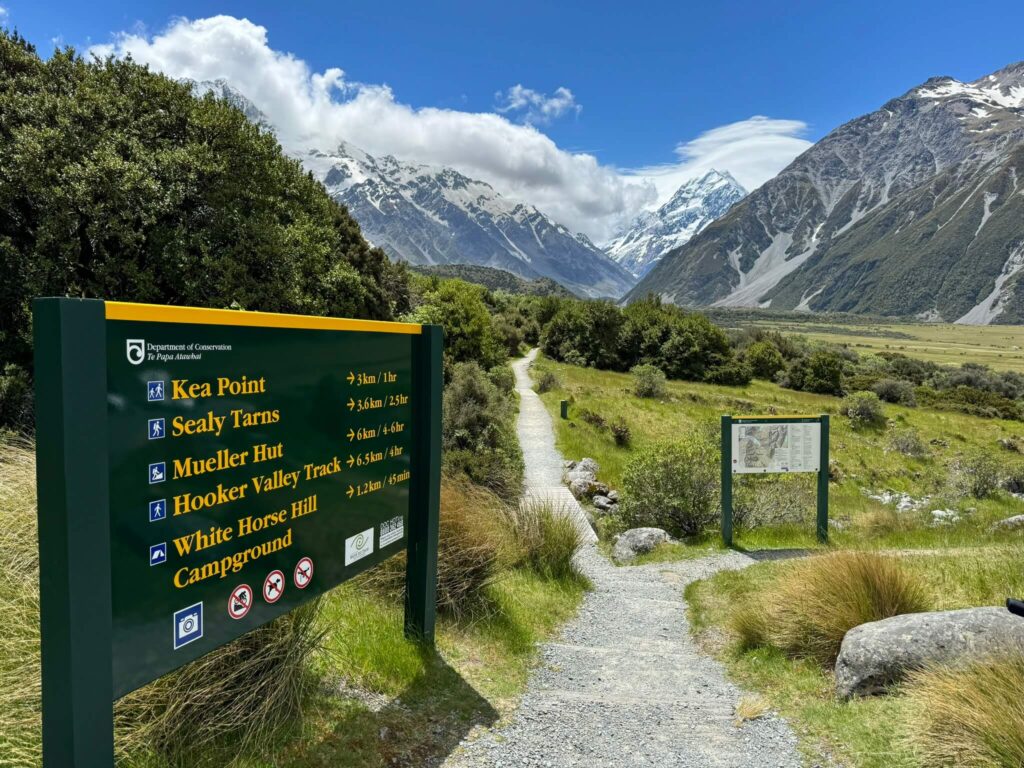
The best hikes near Mount Cook

Hooker Valley Track
The absolute classic in this park is the Hooker Valley Track. We started early in the morning to avoid the crowds. From the very beginning we walked along the Hooker River, with the mountains all around us. The path is wide and easy to walk, so you can keep a good pace.
Our favourite part was the three swing bridges you come across along the way. Every time you cross one, a new view opens up. Sometimes you’d spot glaciers in the distance, then again the rugged peaks of the Southern Alps. In the end we reached Hooker Lake, with floating icebergs on the water and Mount Cook right in front of you. We were lucky: a clear day, so the summit was perfectly visible.

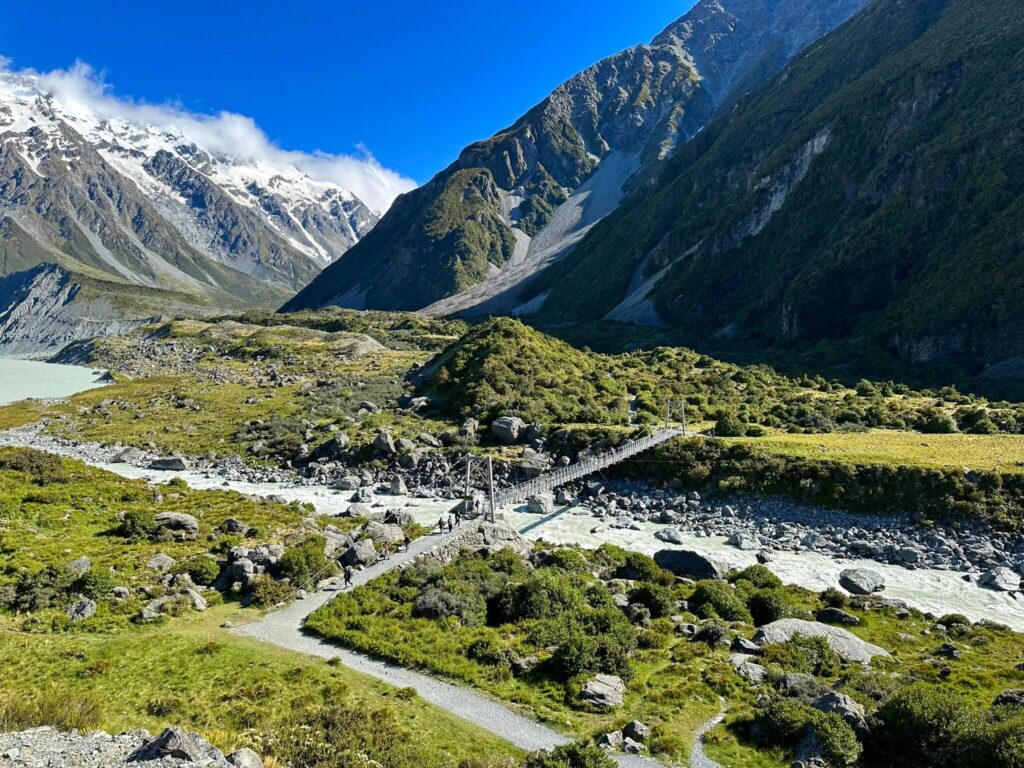

This was actually our last hike of the trip — and what a finale! It took us a bit over three hours, including lots and lots of photo stops.

What was kind of funny: I was wearing shorts and a sports shirt. During the walk you also meet a lot of Chinese travellers (it’s a much shorter flight for them than it is for us). They were all bundled up! Winter jackets, beanies… everything to stay out of the sun. Funny to see those (cultural) differences.
Practical:
- Best time: start early to avoid the crowds; in summer it can get warm and the trail can be busy
- Distance: 11 km return (around 3 hours)
- Difficulty: easy, just a bit longer
- Starting point: White Horse Hill Campground (the car park can fill up quickly if you arrive later. I’d go early, otherwise you’ll have to park further away).
Do check whether the Hookey Valley Track is open. In 2025 & 2026 it was temporarily closed due to maintenance work.
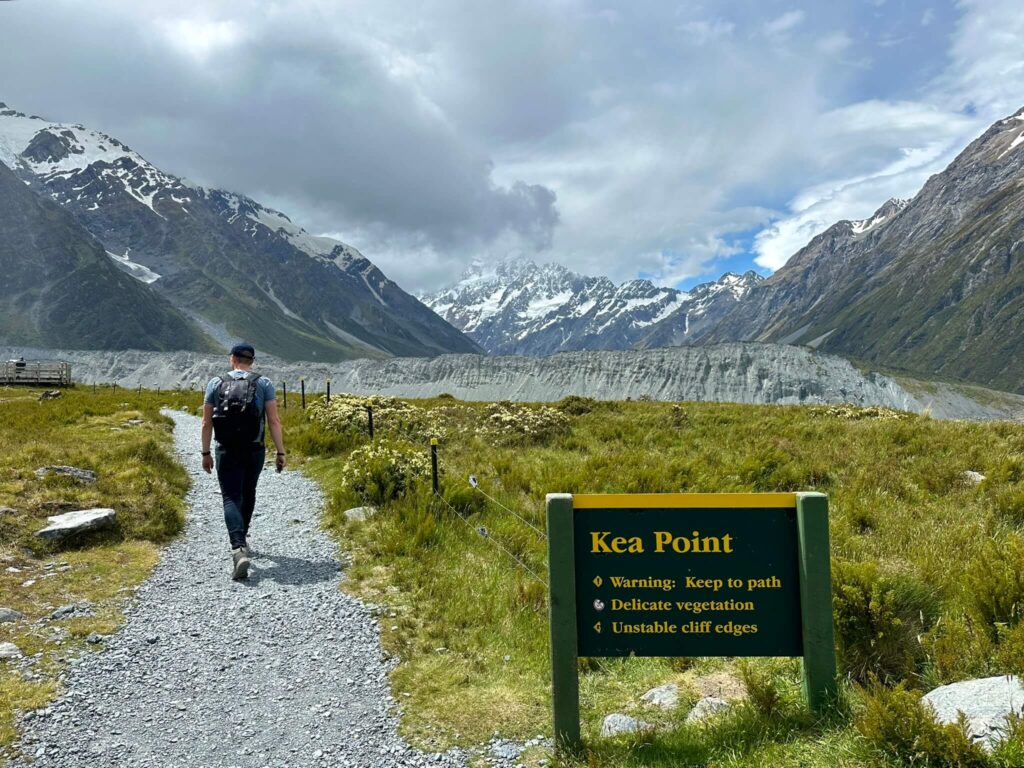
Kea Point Track
Our first walk in Mount Cook National Park was the Kea Point Track. The trail starts near Mount Cook Village and climbs gently through a landscape of subalpine grasslands, low shrubs and gravel. It was a relaxed walk of about six kilometres return — perfect to ease into things.
After about half an hour we reached the viewpoint. And wow — what a view: in front of us we saw Mount Sefton, The Footstool, the moraine wall of the Mueller Glacier, the green Mueller Lake and, of course, Aoraki/Mount Cook in the distance. We stayed here for a while (although it was pretty windy that day, so the extra layer had to go on). A great warm-up if you’re here!
Practical info
- Distance: 6 km return (around 1–2 hours)
- Difficulty: easy, suitable for everyone
- Starting point: White Horse Hill Campground or Mount Cook Village
- Best time: afternoon or late afternoon for beautiful light
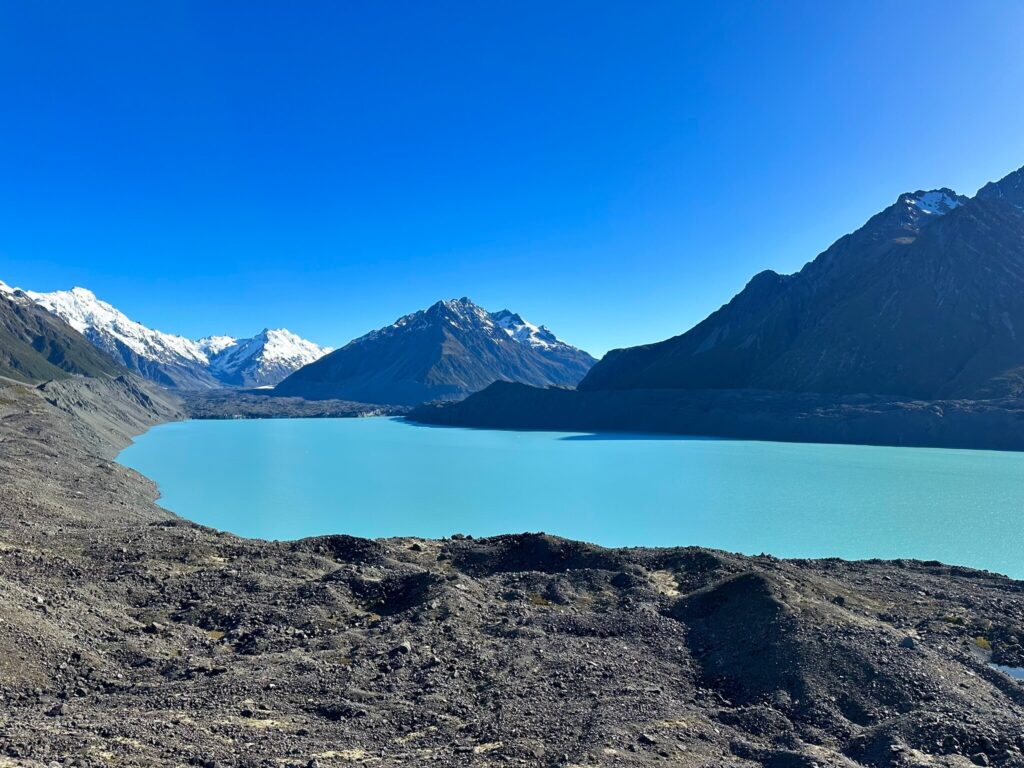
Tasman Valley & Blue Lakes
On our second morning we headed out early, before the crowds arrived. This short but steep climb took us to the Blue Lakes and the viewpoint over the Tasman Valley. Fun detail: the Blue Lakes are actually green these days, because the glacial water that once fed them has retreated.
After the climb we were rewarded with a view over the Tasman Glacier and the huge glacial lake with floating icebergs. You can really see how nature is changing here: the glacier is slowly retreating, and the lake gets bigger every year. Still, it remains an impressive sight — especially with Mount Cook and the Southern Alps in the background.
Practical
- Duration: about 30–45 minutes return
- Difficulty: short but steep
- Starting point: car park on Tasman Valley Road
- Best time: morning for soft light and fewer people
Mueller Hut & Sealy Tarns (optional for adventurers)
We didn’t do this hike, but I still want to mention it. The Mueller Hut Route is one of the toughest day hikes in the park, but also one of the most spectacular. Via the so-called “stairway to heaven” you climb hundreds of steps up to the Sealy Tarns, and if you keep going, you’ll eventually reach Mueller Hut. From there you get panoramic views over Mount Cook, glaciers and valleys.
Practical
- Duration: 5–6 hours return to the hut
- Difficulty: hard, with a lot of elevation gain
- Starting point: White Horse Hill Campground
- Best time: summer months; in winter there may be snow and you’ll need alpine experience
A boat trip on Lake Tasman
We had booked a boat trip on Lake Tasman, at the foot of the Tasman Glacier. Unfortunately our tour didn’t go ahead due to a broken boat. Still, I want to recommend this experience, because normally you cruise between the icebergs and see up close just how massive the glacier really is. Sometimes you even hear chunks of ice breaking off and crashing into the water.
If you have enough time, this is a great way to mix things up during your stay in Mount Cook. It gives you a completely different perspective than hiking.

How to take the iconic Mount Cook Road photo
Your road trip through New Zealand isn’t complete without a photo on the famous Mount Cook Road. On social media you’ll often see people posing right in the middle of the road with Mount Cook in the background.
Big disclaimer: this is a road where cars drive 100 km/h. So never just stand in the middle of the road. Want to take a photo safely? Pick a moment when there’s absolutely no traffic, or take your photo from the shoulder. The view from there is just as spectacular.
In my separate blog I explain exactly where to find the best spots for this photo.

Where to stay in Mount Cook Village: our stay at The Hermitage
We stayed at The Hermitage Hotel, the most famous hotel in Mount Cook Village. According to the internet it’s even “world famous”, and we can confirm that. From our suite we looked straight out at Mount Cook. A view you truly never get tired of.

After a day of hiking it was amazing to come back here, open a bottle of wine and just stare at the mountain in silence with a glass in hand. One moment the sky turned golden from the setting sun, the next we watched clouds drift across the summit. Every hour the view looked different again.
In the evening we had dinner at the Panorama Restaurant, where you get that insane view again while you eat. The food is a bit fancier than what we were used to during our trip, but this is one of those places where you just treat yourself.

Stargazing above Mount Cook
And then something magical happened. Around half past two at night we woke up and decided to go outside. Mount Cook sits right in the Aoraki Mackenzie Dark Sky Reserve, one of the darkest places on earth. There’s barely any light pollution, and you notice that immediately.
We stood outside in the cold, but we forgot about that the moment we looked up. Thousands of stars were sparkling in the sky, and the Milky Way was clearly visible with the naked eye. It felt like we were in a planetarium — but real. And this is simply what you see without a telescope or a camera.
Our tip: set that alarm, even if you’re tired after a day of hiking. Step outside in the middle of the night for a moment. You’ll be amazed. The photo above was taken with my iPhone!
Practical tips & FAQ about Mount Cook
It’s a special place — so here’s a handy FAQ!
How do you get to Mount Cook National Park?
- From Lake Tekapo: about 1 hour’s drive (70 km).
- From Queenstown: about 3.5 hours’ drive (265 km).
- From Christchurch: about 4 hours’ drive (330 km).
Best time to visit?
- Summer (Nov–Feb): long days, blooming flowers (including lupins), perfect time for hikes.
- Winter (Jun–Aug): snow and colder temperatures, but also a fairytale landscape.
Facilities in Mount Cook Village
- Restaurants and cafés (including the Panorama Restaurant at The Hermitage). You can also easily grab lunch here. The car park is big enough.
- DOC Visitor Centre (Department of Conservation) for up-to-date info on hikes.
- Limited shopping options, so bring enough snacks yourself.
Stargazing
Mount Cook is in the Aoraki Mackenzie Dark Sky Reserve. You can see the Milky Way with the naked eye here. There are also stargazing tours, but you can often enjoy it straight from your accommodation.
Hooker Valley Track maintenance (2025–2026)
Keep in mind the Hooker Valley Track may be partially closed during this period due to maintenance on bridges and paths. Always check the latest info on the Department of Conservation website before you go.
Other things to do in Mount Cook National Park
1. Scenic flights & helicopter tours
From Mount Cook Village or nearby Glentanner you can fly over the Southern Alps in a small plane or helicopter. Sometimes you even land on a glacier. It’s quite pricey, but many travellers call this the highlight of their entire trip.
2. Sir Edmund Hillary Alpine Centre
At The Hermitage Hotel you’ll find a small museum and planetarium about mountaineering and the history of Mount Cook. Nice if it’s raining or you want something relaxed.
3. Bowen Bush Walk
A short walk (20 minutes) through a forested area near Mount Cook Village. You follow the Glencoe Stream and can spot plenty of birds. Ideal if you have an extra hour or just want a quiet stroll.
4. Red Tarns Track
A steep but short hike (about 1.5–2 hours return) to a viewpoint over Mount Cook Village. At sunset the mountains glow a beautiful red — that’s where the track gets its name.
5. Stargazing tours
Besides stepping outside on your own, you can also book guided tours (for example with Big Sky Stargazing). You’ll get telescopes and explanations from a guide.
6. Kayaking on Lake Tasman
In addition to the boat trip, in summer you can also kayak out onto the glacial lake. That means paddling literally between the icebergs. Definitely something you only do in summer.

Saying goodbye to Mount Cook and continuing to Lake Tekapo
After three full days it was time to say goodbye to Mount Cook. It almost felt like we wanted to stay much longer. We hiked, soaked up the views, went stargazing and just took a moment to appreciate how stunning nature is here.
The drive back along Mount Cook Road was a gift in itself. This long straight road runs right alongside the bright blue Lake Pukaki, with Mount Cook straight ahead of you. At every bend the camera had to come out again, because the view somehow kept getting better. It’s without a doubt one of the most beautiful drives we did in New Zealand. On the way there it’s even more fun than on the way back, because you’re driving towards Mount Cook.
From Mount Cook we continued to Lake Tekapo, another place high on our wishlist. Here we were treated to more azure-blue water, blooming lupins and an evening full of stars at Tekapo Springs. A perfect wrap-up to this part of our trip, because shortly after this we had to hop on the plane back home.

New Zealand in Google Maps
We make your road trip easy by sharing 200+ points of interest & 300+ campgrounds in New Zealand with you via Google Maps in just a few clicks.
€ 2.95

