


New Zealand is made for a road trip. Mountains, fjords, deserted beaches and a different view every ten minutes. With a rental car, you experience this country at its very best, at your own pace, with your own playlist and the freedom to stop wherever you want. We traveled through New Zealand for four weeks with a rental car and I can honestly say: it was truly an unforgettable journey! In this blog, I’ll tell you how it went with a rental car, what to look out for and I’ll share my best tips if you’re planning to rent a car in New Zealand yourself.
Contents
Why We Chose a Rental Car Instead of a Campervan
At first, we were still deciding between a car and a campervan. A campervan is of course convenient if you like staying right in the middle of nature, but we chose a car with hotels and B&Bs. After a long day of travel, we could simply pick up the key to a hotel or B&B, check in and take a warm shower right away. And honestly: New Zealand has so many great boutique hotels and cozy lodges that it felt like a little celebration every few days. Oh, and one more argument: in four weeks, the maximum temperature we had was 23 degrees Celsius. If you’re used to camping in warm weather, that can be a bit disappointing in New Zealand.
With a car, we could also drive anywhere more easily, stop at viewpoints or spontaneously go for a walk. For example, on the way between Wanaka and Queenstown we came across a picnic spot with mountain views. We simply sat there for an hour with our sandwiches and Christmas music playing in the background. You don’t get moments like that on a group tour. The roads are also not as straight as the ones we’re used to back home in the Low Countries. Imagine driving on 80 km/h roads (where you’re allowed to drive 100 km/h in New Zealand), but with constant curves. Sometimes you’ll also need some proper cornering skills to make it up a mountain. Well, if you’re driving that campervan, I’ll be overtaking you in the rental car!
Generally speaking, you’re not in a rush in New Zealand. A campervan works just fine too. A rental car simply gives you a different kind of freedom compared to a campervan. The combination of a rental car + hotels is often more expensive. Think carefully about how you want to experience your adventure!
Alright, long story short. Here are the main differences between renting a car & a campervan in New Zealand:
| Renting a Car in New Zealand | Renting a Campervan in New Zealand |
|---|---|
| More comfort: after a long day, you drive to your hotel or B&B for a warm shower and a good bed. | Stay overnight in the middle of nature, often at campsites or free spots. |
| More convenient in colder weather – we had a maximum of 23 degrees in four weeks. | Less comfortable in rain or cold, especially outside peak season. |
| Easier driving in the mountains and on winding roads. | Larger vehicle, less maneuverable on mountain passes or narrow roads. |
| Faster on the road – ideal if you want to see a lot. | Slower pace, everything at hand in your “home on wheels”. |
| Less flexible for overnight stays, but more choice in charming lodges and B&Bs. | More freedom to stop spontaneously and sleep where permitted. |
| Slightly more expensive due to separate hotels, but more comfortable. | Often cheaper if you cook and camp a lot yourself. |

What You Need to Know Before Renting
Most car rental companies in New Zealand operate quite simply. You must be at least 21 years old (sometimes 25) and have a valid driver’s license. We also brought an international driving permit, but it turned out our rental company didn’t even require it. Still, I recommend getting one, as the police may ask for it. The deposit is usually charged to your credit card, so check before departure that your limit is high enough.

Insurance is another thing to consider. Basic coverage is standard, but pay attention to the excess: it can add up quickly. We chose extra coverage for windows and tires, because some roads – especially on the South Island – are gravel. That gave us a bit more peace of mind on the road. And believe me: if a small stone hits your windshield, you’ll be glad you arranged that. We experienced it before during our vacation in the United States. Back then, returning the car was also a breeze thanks to our insurance.
How Much Does It Cost to Rent a Car in New Zealand
Prices vary enormously depending on the season. We traveled in November & December (still before Christmas), which is already peak season. At that time, we paid around €60 per day for a compact SUV. In the low season (April to November), it can be significantly cheaper. Fuel prices are comparable to the Netherlands, but you will drive more kilometers. So keep in mind a slightly larger fuel budget. For four weeks, we ended up spending around €2,000 in total on rental, fuel and insurance. Not cheap, but worth every euro for the freedom you get.
Want to get an idea of the current prices?
Driving in New Zealand: It Takes Some Getting Used To, but It’s Amazing
The first few kilometers were a bit exciting – driving on the left! – but after about half an hour, you really get used to it. Most roads are quiet and well maintained. What stands out is that New Zealanders drive incredibly politely. No one pushes or honks. Only the one-lane bridges took some getting used to: sometimes you go first, sometimes you don’t. Fortunately, it’s clearly indicated everywhere.

The route to Mount Cook on the South Island was one of the most beautiful stretches of our trip. You drive alongside the bright blue waters of Lake Pukaki and see Mount Cook getting bigger and bigger on the horizon. We stopped every few kilometers for photos. That view, with the perfectly straight road and the mountains in the background, is one of the most famous images of New Zealand – and believe me, rightfully so. Want to take the photo above as well? Here you can read where to go.
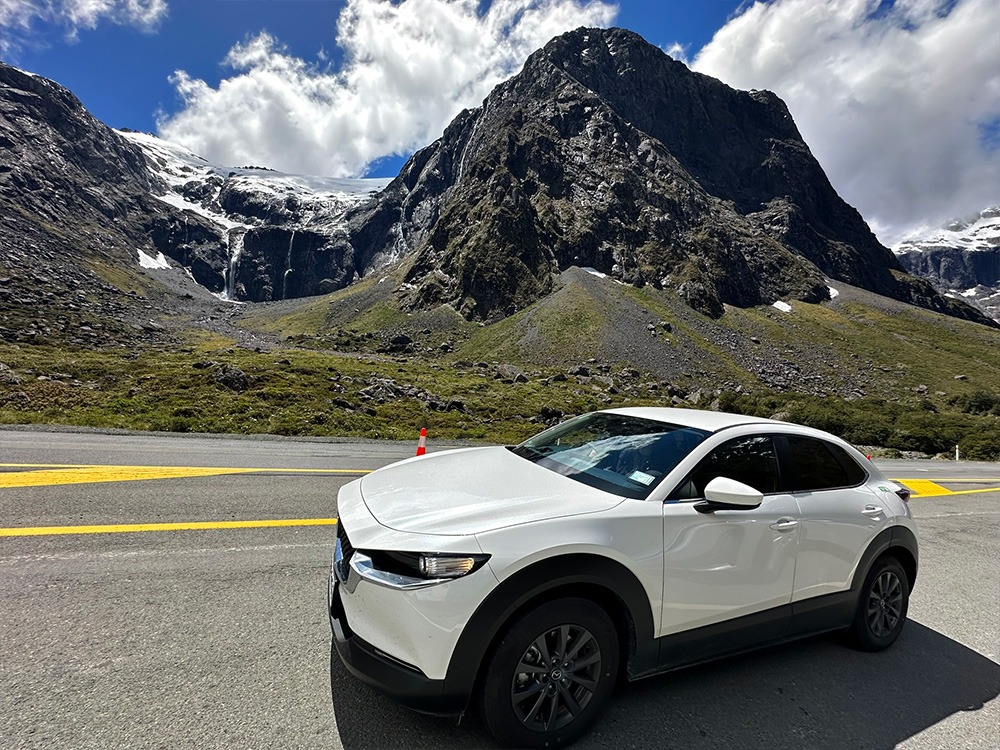
The road to Milford Sound from Te Anau is also legendary. You drive through dense forests, over high mountain passes and through the narrow Homer Tunnel. Around every corner, a new landscape is waiting. We drove slowly, with the windows open and the smell of rain in the air. Tip: stay here for a while and only leave the park after sunset. By then, all the tour buses are gone and everything feels even more beautiful.
Choosing the Right Car
What kind of car you need depends on your route. On the North Island, a compact car is perfectly fine. There are more shops and inhabited areas thanks to cities like Auckland, Rotorua and Wellington. On the South Island, you drive through more remote and rugged areas. We had a Mazda CX30, spacious enough for our suitcases and comfortable on long days. Anything that’s somewhat SUV-like (for example a Toyota RAV4) works well. Assume that you’ll spend more time in your car than in your hotels. Most newer cars come with CarPlay. So arrange internet access and simply navigate through New Zealand using Google Maps (tip: download our Google Maps route).
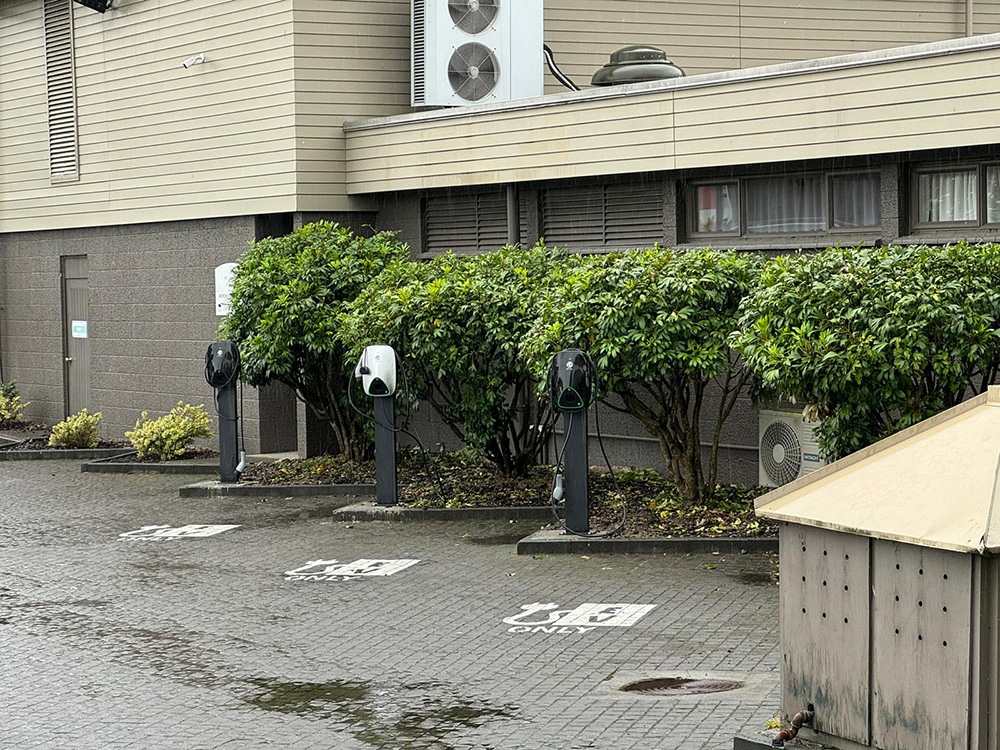
Driving electric is also becoming easier. Especially around Auckland, Wellington and Christchurch you’ll find plenty of charging stations. In more remote areas it’s still somewhat limited, so if you want to drive electric, planning is important. I previously wrote about this in my blog renting an electric car in New Zealand.

Where to Pick Up Your Rental Car in New Zealand
Most travelers start their road trip in Auckland or Christchurch – these are the two main pick-up locations in New Zealand. We picked up our car in Auckland, right after arriving at the airport. Super convenient, because after a long flight you can immediately drive towards Coromandel or Rotorua. If you enter via the South Island, Christchurch is an ideal starting point. From there, you’ll reach Mount Cook or the west coast in no time.
With many rental companies, you can also return the car in a different location from where you picked it up. Convenient if, like us, you take the ferry from the North Island to the South Island. Indicate this in advance when booking, as there is sometimes a small surcharge for one-way rentals.
Convenient Pick-Up Locations
| Location | Why Start Here | Link |
|---|---|---|
| Auckland | Ideal starting point for the North Island. Close to Coromandel, Rotorua and Hobbiton. | Check available cars from Auckland here |
| Christchurch | Popular starting point for the South Island. Quickly on your way to Mount Cook, Tekapo and the west coast. | Check available cars from Christchurch here |
Parking, Toll Roads and Fuel
Parking is free in most towns, except in the centers of larger cities. In Queenstown and Wellington, you often pay per hour via an app. Toll roads are rare and usually electronic. You’ll receive an email afterwards or your rental company will charge it automatically. Refueling is mostly self-service; debit card or credit card works perfectly fine. We often refilled the tank when it was still half full – simply to avoid being surprised in an area where you might not see a gas station for an hour.

Driving Safely: What I Noticed
New Zealand is extremely safe for driving, but don’t underestimate the distances. What looks like an hour on the map can sometimes take longer. Roads often wind through mountains or along lakes. New Zealand is also very well known for roadworks. Often it’s nothing major, but sometimes you just need a bit of patience. The weather can also change quickly. We once left in sunshine and drove into dense fog an hour later. So always check the weather forecast, especially if you’re driving mountain passes like the Lindis Pass.
Also: don’t leave valuables visible in the car. Not that we experienced anything, but it’s always better to keep your camera and passport out of sight. And when picking up the car, always walk around it with your phone camera: a few photos of scratches and the mileage can be useful later.

The Most Beautiful Road Trip Routes
New Zealand is packed with scenic drives, but these are our favorites:
Coromandel Peninsula: winding coastal roads, hidden beaches and the magical Cathedral Cove. The drive between Thames and Hahei is fantastic, especially at sunset.
West Coast: from Punakaiki to Franz Josef. Rugged cliffs, rainforest and the remarkable Franz Josef Glacier. Hopefully you’ll have better weather than we did at this beautiful glacier.
Wanaka to Queenstown: via the Cardrona Pass, past the famous bra fence and the charming Cardrona Hotel. One of the most enjoyable in-between drives of our trip.
Te Anau to Milford Sound: an absolute must. Every corner looks like a postcard. Make sure to stop at the Mirror Lakes and take your time.
Mount Cook Road: possibly the most beautiful road of all. The combination of Lake Pukaki and the snow-capped peaks of Mount Cook is truly unreal.
You can find our complete route, including all stops, hikes and hotels here: four-week New Zealand itinerary.
Returning the Car
The day of returning the car felt almost a little sad. After four weeks, our car had become something like a travel buddy. We had experienced so much with it: long drives, spontaneous stops, mud, mountains, and endless coffee along the way. Fortunately, returning it went smoothly. We had filled up the tank, shaken out the dust and taken a few photos. Within ten minutes, we were standing at the counter at Christchurch Airport with our suitcases. Ready for the flight to Sydney and back home.
Now You Know Everything About Renting a Car in New Zealand
Renting a car in New Zealand is the best choice if you’re looking for freedom, convenience and adventure. You set your own pace, discover places that aren’t in travel guides and can literally stop wherever you want. Book in advance, especially in the summer months. Check the insurance conditions regarding gravel roads and take the time to enjoy the drive itself – because in New Zealand, the road is just as beautiful as the destination.
Want to check rental prices or see which cars are available? I always choose my rental car at Discover Cars because of their excellent conditions. Enjoy planning – and have an amazing road trip!

New Zealand in Google Maps
We make your road trip easy by sharing 200+ points of interest & 300+ campgrounds in New Zealand with you via Google Maps in just a few clicks.
€ 2.95

